If This House Could Talk -- Blog post #27 -- Ever Smaller World
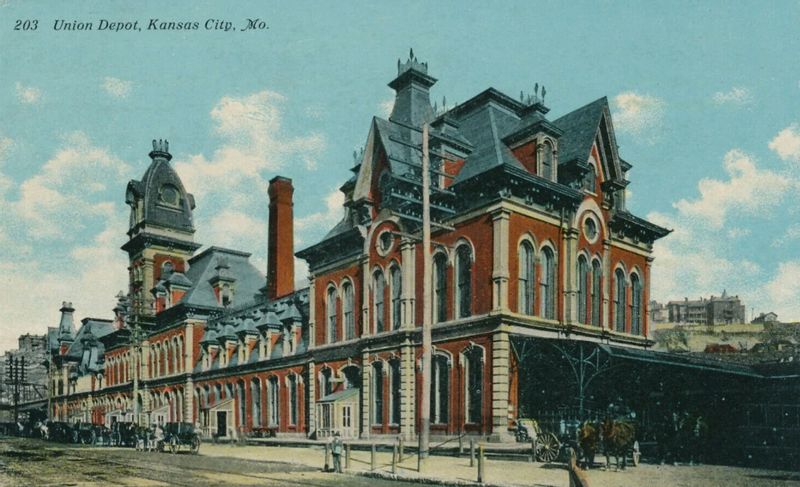
By the turn of the 20th century train travel was so much quicker. When Charles took a business trip to Kansas City in 1894, he left Marysville on the 2:20 am train and returned at 1:00 am the next day. He remarked, “In 24 hours (I) have lived through a period that 25 years ago would have required the time of ten days.”
Similarly, the round trip to St. Joesph in the early 1860s by oxen and wagon to get inventory for his brother-in-law’s general store took Charles seven days. Charles told me about his journeys: “With empty team to Seneca 1st day, 2nd day to Wolf River east of Sabetha, 3rd day 2 pm reached St. Joe, then load, next day cross the ferry and reach Troy, then Hiawatha, the 5th day at Guittard, the 6th often time make home at midnight the 7th day.”
On December 31, 1900, he traveled the same distance in 12 hours!
With some planning and a little luck, one could go to Kansas City, conduct business, and return to Marysville within 24 hours. Faster trains and more train lines providing service to and from Marysville made this possible.
I remember that Charles took such a marathon trip in September 1898. From Marysville, he took the 11 am train to Irving and on to Manhattan, arriving at 1 pm. In Manhattan, he caught the 1:25 train to Kansas City, passing through Topeka at 3, and arriving at 5:10 pm in KC. There he took the “elevated cars” to the Bank of Commerce and although it was closed, he met with the president and cashiers. After that meeting, he left KC at 6:15 pm for St. Joeph via Leavenworth at 8 pm and on to Atchison and across the Missouri River. He arrived at St. Joe at 9:10 pm but missed the passenger train west. Since the next one would be at 10 am the next day, he waited for the 11:30 pm freight train. It left St. Joe at 1 am. Charles slept fitfully in the caboose; he arrived home at 10:30 am and was at his office at the Exchange Bank of Schmidt & Koester at 11:30 am.
The Union Depot in the west bottoms area of Kansas City is pictured above. It operated from 1878 to 1914. I can only imagine what Charles and the children thought as they passed through it on their visits. The station featured turrets, gables, arches, and a 125-foot clock tower, resembling a European castle more than a Midwestern depot. Inside they would have found marble floors, vaulted ceilings, and frescoed murals, creating a luxurious experience for the era.