If This House Could Talk -- Blog Post #24
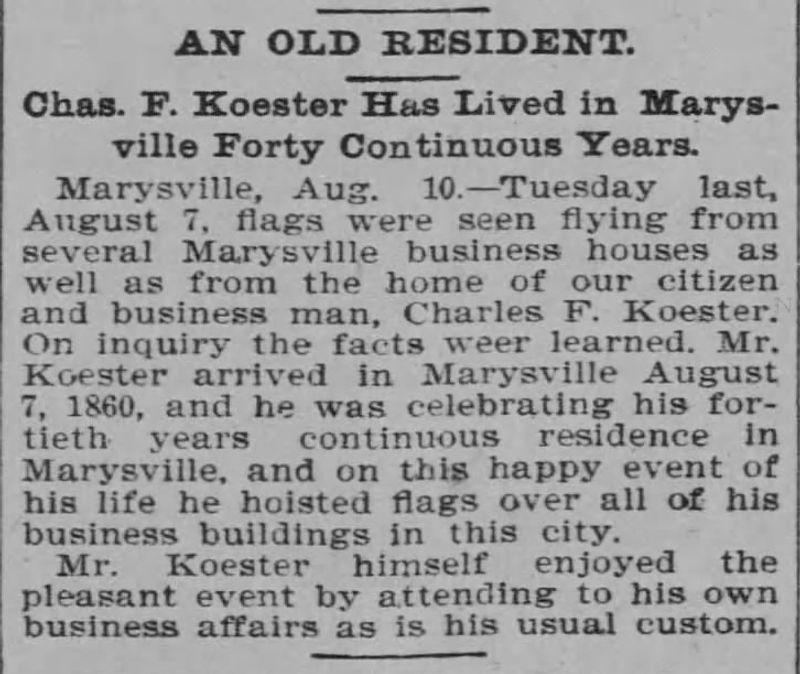
Charles didn’t miss anniversaries. August 7, 1900, was a meaningful one. It was the 40th anniversary of his arrival in Marysville. He hoisted flags on his buildings and me to celebrate the milestone.
The 40th anniversary was reported in 65 newspapers throughout the state of Kansas. From Topeka to Wichita to Hutchinson to Dodge City, and in Great Bend, Hays, McPherson, Dighton and Kiowa, they read the news. The Wichita “Printer” commented, “He came there (Marysville) a boy without capital.” The Marshall County News added “…he himself enjoyed the day in the usual way—looking after affairs.”
Charles lived through transformative times in Marysville. His experiences personified the changes in lifestyle that occurred during the 40 years.
When he arrived in 1860, Marysville had been founded just four years earlier. Kansas was not yet a state. Freight was hauled by ox trains. Passengers traveled by stagecoaches. The Pony Express had started four months earlier.
It took Charles and family five grueling days in 1860 to make the trip from St. Joseph, Missouri to Marysville by oxen-pulled wagons. Charles bragged to me in 1900 that he traveled the same distance by train in 12 hours.
Charles and family spent their first night sleeping on the floor of the unfinished shell of the building that was to be their general store. Over the years, Charles built me and my additions, added outbuildings, constructed a greenhouse, and surrounded me with gardens, fountains, and statutes. By 1900, I had the latest in conveniences—an ice box, city-supplied water, and a telephone.
Charles used coal oil lamps for lighting even before I was built. Now I’m lit by 22 electric lights including two lights in the lawn and a light in the greenhouse. Upon arriving in 1860, Charles was a clerk in his brother-in-law’s mercantile, a saloon operator, Registrar of Deeds, and County Treasurer, before joining his brother-in-law, Frank Schmidt, at the Exchange Bank in 1872. By 1900, Charles was President, and the Exchange Bank had assets of $392,000 ($15,000,000 in 2025 dollars).
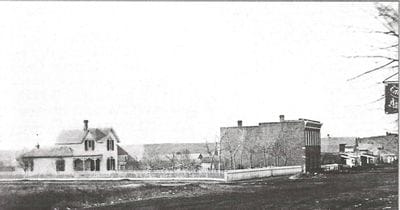
Marysville when Charles arrived was a treeless prairie with a few log cabins. Charles built a two-story brick building along Broadway in 1870 and the first three-story building in 1880. These buildings had retail on the first floor and offices above. One of those offices was occupied by Dr. Jennie Edington, a woman physician. The new Exchange Bank was built in 1881.
Marysville’s population grew from approximately 150 residents in 1860 to 2196 in 1900. With the growth in population came a proliferation of institutions and organizations—schools, churches, service clubs, community centers—to serve the community. Charles was very involved.
Starting in 1857, Methodist ministers held services at various venues including a saloon. By 1900, there were five churches. Charles was active at the Episcopal Church, serving on the vestry, lodging the Bishop at his home when he was in town, and supporting the church’s fundraisers. Charles also donated the land on which the German Evangelical Church was built.
The Independent Order of Odd Fellows held their meetings on the third floor of Charles’ three-story building. His service to them was recognized with the Odd Fellows Jewel.
Turner Hall, built in 1880 by the German society Turnverein, was a de facto community center. Charles was always going to some event there—a lecture, a recital, a play, a concert. He would come back raving about an opera he heard or bragging about the performances given by his daughters Tinnie and Jennie at their recitals.
Charles was proud to have lived continuously in Marysville for 40 years and to have been a part of the community. He was pleased by the coverage that his anniversary received. In fact, he clipped the August 10, 1900, article from the Topeka Capital Journal (pictured above) about his 40th anniversary to put in his diary.
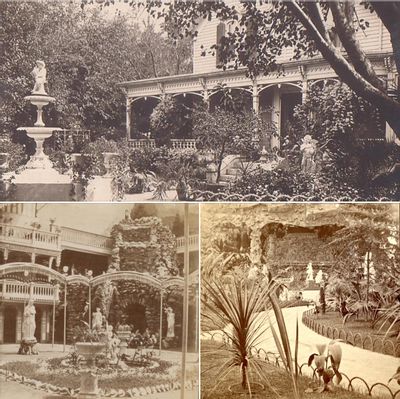
CELEBRATING 150 YEARS—Why Sculptures?Ever wonder why Charles F. Koester had sculptures in his garden? Credit can be given to his being at the Centennial Exposition in Philad...
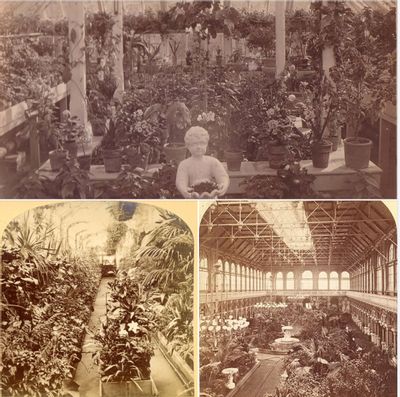
CELEBRATING 150 YEARS by Earl ShreckengastCELEBRATING 150 YEARS—Centennial Influences on Koester Gardens We often don’t think about why things are the way they are. That could be...
September 22, 2026 -- The Newlyweds Settle In by Earl Sh... CELEBRATING 150 YEARS The Newlyweds Settle In Sylvia and Charles Koester returned to Marysville from their honeymoon on September 9, 187...
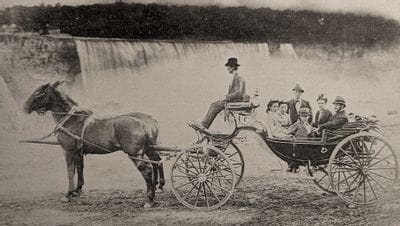
September 15, 2026 Blog The Honeymoon by Earl ShreckengastCELEBRATING 150 YEARS— The Honeymoon Having traveled for five weeks, the honeymoon party arrived at what was becoming the honeymoon dest...